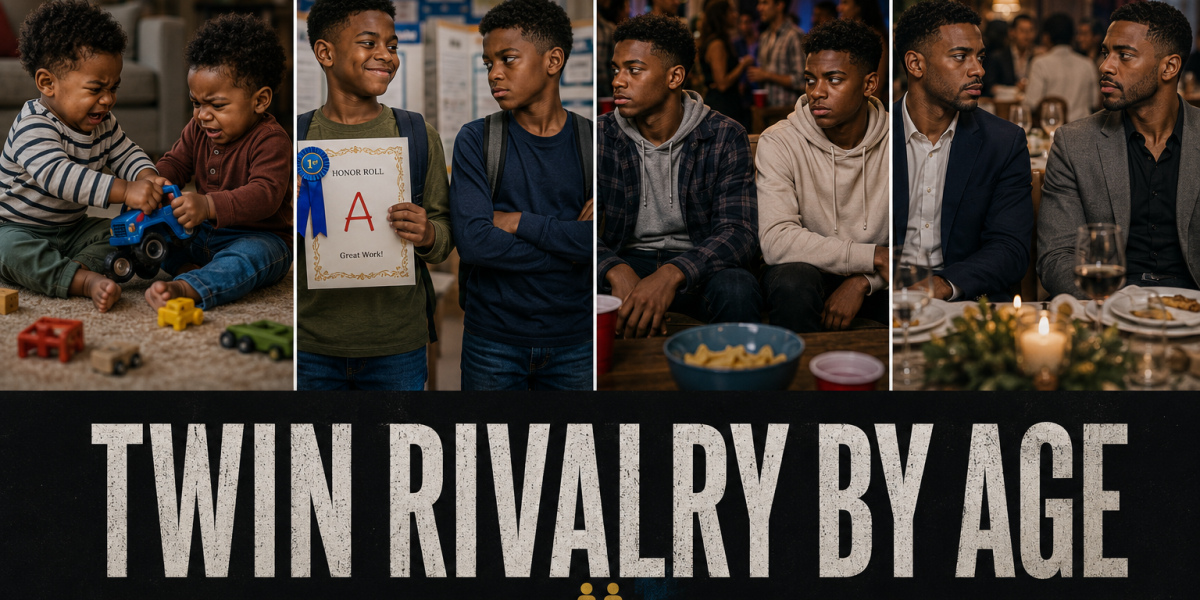

Twin Rivalry Doesn’t Stay the Same — It Evolves
Twin rivalry is not a phase that starts in toddlerhood and ends when your children grow up. It shifts — in form, intensity, and meaning — at every stage of life.
The competition that two three-year-olds wage over a toy is genuinely different from the friction between same-sex fraternal twins navigating middle school popularity, which is genuinely different again from the resentment that can quietly accumulate between adult identical twins as their lives diverge in different directions.
Understanding which version of rivalry you are dealing with matters, because the responses that work at one stage often don’t work — and can actively backfire — at another. This article tracks the arc from toddlerhood through adulthood, drawing on what research and clinical practice tell us about each stage. For the foundational framework — including the critical jealousy vs. envy distinction and how twin type shapes rivalry overall — see Why Twins Fight. This article was updated in September 2026 with newer peer-reviewed research; where the evidence is limited, it says so.
Toddlers (Ages 2–5): Everything Is a Competition, and That’s Normal
Toddler twins fight over toys, physical space, and parental attention — constantly, loudly, and without much apparent logic. One twin wants what the other has, not because the object is particularly desirable, but because possession is how toddlers signal status and security. When the same object belongs to a co-twin who is always present, always the same age, and always competing for the same limited pool of parental attention, the conflict is essentially structural.
The same-age dynamic is the key difference from ordinary sibling conflict at this stage. Parents of older and younger siblings can tell the older child that the younger one isn’t ready yet, or reassure the younger one that they’ll be able to do what their sibling does when they’re older.
With twins, that scaffold doesn’t exist. Both children are in the same developmental window simultaneously, which means every perceived inequality feels immediate and urgent.
What helps at this stage is creating genuinely separate spaces and experiences — not just physical separation when conflict erupts, but proactive individuation: activities that belong to each twin individually, one-on-one time with each parent, and wherever possible, objects that are unambiguously each child’s own. Research supports giving twins some possessions that they are not required to share, precisely because the experience of owning something as an individual — not as one of the twins — is foundational to developing a sense of self distinct from the twinship.
A calm-down corner or quiet space where either twin can go when overwhelmed is more effective at this stage than punishment. Toddlers are not yet capable of the kind of reasoning that consequences require. What they need is de-escalation and, over time, the modelled experience of working through conflict rather than being removed from it.
Who Gets to Speak?
One pattern worth watching at this age is which twin answers questions and makes the decisions. Nurses who work with multiple-birth families in Finland described twins under age seven taking on different roles: one taking up more space, one making the decisions, one following from the sidelines, one helping, one taking the lead in speaking. Those observations come from a cross-sectional survey of 72 nurses. The study surveyed 72 nurses, not 72 twin pairs, so it does not show how common these roles are, and it does not show that speaking for a sibling causes developmental problems.
A practical step, offered as editorial guidance rather than a finding of that study: when both children are asked a question, wait and give each one a turn to answer before either does. If one twin habitually answers for the other, hand the question back.
School Age (Ages 6–11): When the Outside World Joins the Comparison
The school years introduce a new and powerful driver of twin rivalry: the opinions of other people. Teachers compare twins’ academic performance. Coaches compare their athletic ability. Classmates notice who is more popular, who is funnier, who gets in trouble more. For the first time, comparison is not just happening at home — it is happening in public, with an audience.
This is also the stage when twins begin to understand that their co-twin’s performance reflects on them. If one twin excels academically and the other struggles, the struggling twin is not just dealing with their own difficulty — they are dealing with it in the shadow of someone who shares their face, their name, and in many cases their classroom. Research on sibling rivalry shows that when one child is outperformed by a same-age sibling, they are significantly more likely to abandon that activity entirely rather than continue to compete. For twins, this can mean one child walking away from academic subjects, sports, or social activities that their twin is better at — not because they lack ability or interest, but because the comparison is too costly.
Roles set in the early years can also follow twins into school. In one longitudinal study of 1,521 twin pairs followed from about age 3 to ages 8–9, parents perceived the typically developing twin as more dominant in pairs where the other twin had a developmental difference, and that perception continued even after the original difficulty had resolved (Segal et al., 2025). The study ends at ages 8–9, so it says nothing about the later school years, and it reflects parents’ perceptions rather than direct observation. It does not show that roles are fixed.
Editorial takeaway (not a finding of the study): check whether a role that made sense earlier is still being handed to one twin, and whether each child has a setting where they are the one who leads.
Parents at this stage should be particularly careful about how they respond to achievement differences. Praising one twin in front of the other for a performance comparison — “your brother finished his homework already, why haven’t you?” — creates resentment without providing any productive path forward. If one twin achieves something significant, celebrate it privately first, then find the equivalent thing to celebrate for the other twin on their own terms.
The goal is not equal outcomes but equal dignity.
Separate activities that each twin can be the best at — without the co-twin present for comparison — become increasingly important at this stage. Dr. Nancy Segal notes that this does not require separate schools or classrooms; it requires separate experiences within whatever shared environment they inhabit. A twin who has a domain that is clearly, unambiguously theirs has less need to fight for distinction in shared spaces.
Adolescence (Ages 12–17): Identity, Comparison, and the Push for Autonomy
Adolescence is when the pressure to be seen as an individual tends to become most visible, and that can make rivalry feel sharper for some twins, although research has not shown that rivalry peaks at this age for twins as a group. Teenagers are in the middle of the most demanding individuation project of their lives: separating from their parents, forming a peer identity, figuring out who they are as distinct people. For twins, this project collides directly with the structure of twinship, which has always organised part of their identity around the pair rather than the individual.
The social world of adolescence can amplify comparisons that have been quietly building for years. Popularity, romantic attention, athletic performance, and academic achievement are suddenly high-stakes in ways they were not before. Same-sex fraternal twins can feel this acutely, because they may be socially close enough to compete in the same arenas while being different enough to diverge in outcomes. A fraternal twin who is more popular, more physically developed, or more romantically successful than their co-twin is not just outperforming a sibling; they may be outperforming someone the world treats as their equivalent.
Research on twins’ self-concept in this age group adds some perspective. In a study of Czech adolescent twins, identical and fraternal twins did not differ significantly on measures of self-esteem, behavioural adjustment, or school adjustment, and scores fell within the normal range for Czech adolescents. That finding comes from a study of 336 twins aged 11–15. Small focus groups (three pairs) described both the emotional security of having a twin and a struggle to be seen as an individual. The study did not measure rivalry, so it cannot say whether rivalry rises or falls in adolescence. It included only 32 identical pairs (against 136 fraternal pairs), relied on questionnaires and parent-reported zygosity, and a result that is not statistically significant does not prove the groups are the same.
The twin who is outpaced at this stage faces a specific psychological challenge: they cannot simply wait until they are older, or tell themselves that different rules apply to them. The co-twin is the same age, in the same grade, navigating the same developmental moment.
The gap, whatever it is, feels definitive in a way that gaps between differently-aged siblings do not.
What helps at adolescence is different from what helped at earlier stages. Punishment and privilege removal as responses to rivalry-driven behaviour tend to have limited effectiveness with teenagers, and may increase resentment toward the co-twin perceived as the source of the problem. Some teenagers do well with individual therapy: separate spaces where each twin can develop their own identity, process their own feelings, and build resilience that does not depend on comparison with their co-twin. Others benefit from joint sessions focused on the relationship. Which fits depends on the pair and on a clinician’s assessment, and none of the research discussed here compares the two.
It also helps to name the dynamic directly with teenagers old enough to understand it: the pressure to be different from your twin, or to outperform them, comes partly from outside the relationship — from a world that insists on comparing you — not just from inside it. Externalising the source of comparison pressure gives teenagers something to push back against that is not their co-twin.
Adulthood: When Rivalry Becomes About Identity
Many people assume twin rivalry is a childhood problem that resolves itself once both twins leave home and establish independent lives. Sometimes it does. More often, it transforms.
Adult twin rivalry, as Dr. Joan Friedman describes it from decades of clinical practice, is often rooted in individuation that was never completed. Twins who spent childhood and adolescence always together — sleeping, studying, socialising in tandem — often arrive at adulthood without having developed the independent resilience and self-definition that singletons build more gradually. When life then requires them to function as fully separate individuals, the gap becomes apparent. And the co-twin, who represents everything they are both connected to and competing with, becomes the focus of that unresolved tension.
Friedman observes that adult twins are more driven to win arguments with their co-twin than to resolve them — more interested in being right than in compromise or empathy. She connects this directly to ongoing identity struggles: twins who are still working out who they are as individuals have less capacity for the emotional maturity that conflict resolution requires, because every disagreement is unconsciously freighted with the larger question of selfhood.
The trigger for adult rivalry re-ignition is often a life milestone that disrupts the perceived balance between twins: one twin marries while the other is single; one earns significantly more; one has children first; one achieves professional recognition the other hasn’t. Friedman notes that twins who have worked hard to maintain harmony and equality in their relationship are especially vulnerable at these moments, because the divergence threatens a balance they have invested heavily in sustaining.
Adult twins navigating this territory frequently describe the same painful paradox: the person who knows them best in the world is also the person they most resent.
The enmeshment that felt like closeness in childhood has quietly become a source of constraint — not because either twin has done something wrong, but because their lives have grown so intertwined that each struggles to find themselves within it.
Not every adult pattern is one of resentment. Research on young adult twins suggests that seeking a distinct identity and valuing closeness often go together. In a study of 20 twin pairs during the transition to college, 15 of the 20 pairs prioritized building separate identities, and the twins also described wanting to keep the emotional closeness, trust, and support of their relationship. The researchers read this as a gradual move toward independence, not a rejection of the twin bond.
That evidence concerns emerging adulthood, the early adult years, and not adult life as a whole. The study was small and relied on interviews and questionnaires, so it cannot tell us how twins in their thirties or forties handle these questions, or what causes rivalry to resurface later.
The path forward for adult twins dealing with unresolved rivalry often starts with individual therapy, ideally with a therapist who has specific experience with twin relationships. The goal is not to repair the twin relationship directly, but to help each twin develop enough individual identity and resilience that the relationship no longer has to carry so much weight. Most twin pairs, Friedman notes, do eventually find their way to a healthier relationship, but in her experience it usually requires each twin to do significant individual work first. Joint sessions help some pairs too, and none of the research discussed here compares individual and joint therapy.
What the Arc Tells Us — and What It Doesn’t
Taken together, the stages of twin rivalry suggest a recurring theme, at least from a clinical point of view: many clinicians read twin rivalry as a story about individuation.
The fights over toys at age three, the social warfare at age thirteen, and the resentment at age thirty-three can all be seen, in different registers, as the same fight — the fight to be known as a person, not just as one of the twins.
Research adds some qualifications. It does not show a single timetable for rivalry, and it points to other influences alongside individuation: how different twins are in temperament, roles that form early and can persist, and how much comparison surrounds them. Twin relationships change with age, but there is no one script that every pair follows.
That reframe does not make any particular instance of rivalry easier to live with. But it does point toward what tends to help at every stage: not managing the conflict from the outside, but supporting each twin’s capacity to be a full, individual person from the inside. When each twin has enough of their own — their own identity, their own achievements, their own relationships, their own space — the rivalry loses much of its fuel.
The third article in this series, When Twin Conflict Goes Too Far, covers the end of the spectrum where rivalry has crossed into something more serious — and what parents and adult twins need to know about getting help.
This article draws in part on the work of Dr. Joan Friedman, PhD, twin psychotherapist, author of Emotionally Healthy Twins and Beyond the Bond, on peer-reviewed studies cited in the text (research sections updated September 2026), and on perspectives shared anonymously by parents in the twin community. Content on Twins Magazine is produced using an AI-assisted editorial process and reviewed by a human editor before publication.