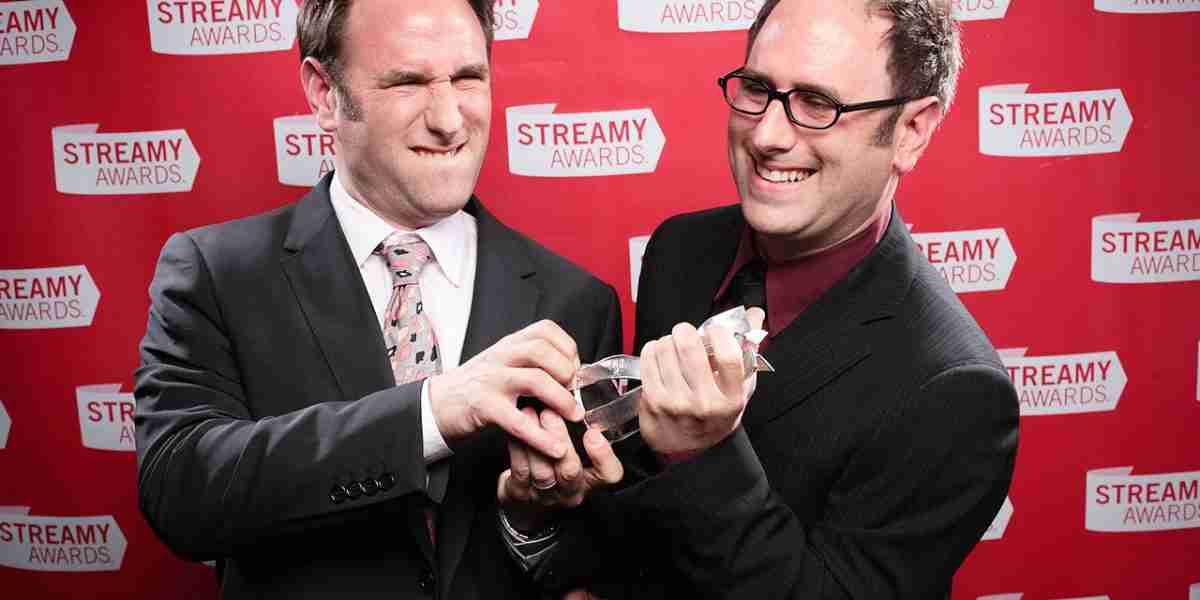

The Sklar Brothers: How Two Twins Built a Career on Twinhood Without Making It the Joke
Here is a question that any twin in a room with their co-twin has probably been asked at least once: Do you know which one you are? Most twins laugh it off. Randy and Jason Sklar — identical twin comedians from St. Louis, born January 12, 1972 — actually went looking for the answer. What they found on This American Life is one of the most quietly riveting stories about twin identity you will encounter outside a psychology textbook.
The Sklar Brothers are among the most accomplished identical twins working in entertainment today. As stand-up comedians, podcast hosts, actors, and writers, they have built a 30-year career on a foundation that most people would reduce to a novelty. They have refused, consistently, to let that happen.
They Came Up Together — But Not as a Twin Act
Randy and Jason grew up in suburban St. Louis in a Jewish family, watching comedy specials and memorizing routines from Jerry Seinfeld and Sam Kinison. They attended the University of Michigan together, where they briefly considered law school before a conversation with comedian Andy Kindler pushed them toward the stage. In 1994, they moved to New York and built their craft in the alternative comedy scene — showcases like “Eating It” and “Surf Reality,” where the crowd rewarded ideas over polish.
What they developed wasn’t a twins novelty act. As researchers and psychologists have long noted, identical twins share the same DNA but diverge in temperament, personality, and how they meet the world. That divergence is audible in the Sklar Brothers’ act. Randy describes himself as the more emotional one; Jason stays cooler about the career’s ups and downs. Onstage, those differences are the engine. Their delivery sparks back and forth between them — sparring, finishing thoughts, landing on punchlines in unison — in a rhythm that is structurally impossible without a co-twin who has been in the room with you for every experience you’ve ever had.
The New York Times‘ Neil Strauss captured it precisely: their comedy accepts the reality of being twins without leaning on it. Instead, he wrote, they work with their physical and mental similarities — their status as imperfect copies of each other — so that in their act, the straight man is often an echo.
Thirty Years, One Voice
The Sklar Brothers’ credits span nearly every format in American comedy. From 2004 to 2006 they hosted Cheap Seats on ESPN Classic, a riff-heavy sports comedy series that became a cult classic. They recorded stand-up specials for Comedy Central (2001, 2009), released a Netflix special What Are We Talking About (2014), and followed it with Hipster Ghosts on Starz in 2018. Their podcast View from the Cheap Seats ran for over 700 episodes across 15 years before ending in January 2025 — a remarkable run for any podcast, let alone one with two hosts who share a biological history.
On the acting side, they’ve appeared in Curb Your Enthusiasm (an Emmy-winning episode), It’s Always Sunny in Philadelphia, Better Call Saul, Entourage, and Grey’s Anatomy — where, notably, they played conjoined twins. It is the kind of casting that says something about how the industry sees them. They took the role anyway and, by most accounts, were very funny.
The Question Every Twin Recognizes
The most resonant chapter of the Sklar Brothers’ story has nothing to do with television credits. It is a zygosity-adjacent mystery their mother carried for nearly five decades.
Annette Sklar delivered Jason first, then Randy — five minutes later, 5 pounds 2 ounces, straight to an incubator. Two nearly identical newborns, one exhausted mother, one father often away for work. The family rumor, passed quietly through the years, was that she had mixed them up somewhere in those early days and that the boys had been living as each other ever since.
When This American Life investigated the story, Randy dug through his childhood home in St. Louis and found their original hospital footprints. A forensic identification specialist in California compared those infant prints against their adult feet. The result: no mix-up. Jason is still the older twin by five minutes. Randy is still the one who spent his first days in an incubator. The world their mother said they were living in was the world they had been in all along.
It resolved cleanly. But the fact that the question existed at all — that it had floated, unverified, for nearly 50 years — is something any twin family will recognize immediately. The early days of twinhood are logistically overwhelming in ways that stay with a family long after the twins have grown up.
What the Sklar Brothers Understand About Being Twins
The most instructive thing about Randy and Jason Sklar isn’t the career — it’s the framework. They built a professional identity that is entirely, structurally dependent on twinhood, while refusing to make twinhood the joke. Their act only works because they are twins; it just doesn’t work about being twins. That is a careful, considered distinction that took years to develop, and it reflects something that adult twins often describe: twinhood is the context, not the content, of your life.
For twins growing up trying to figure out how to be themselves while always being perceived as a unit, the Sklar Brothers are a useful case study. You don’t have to perform your twinhood. You also don’t have to hide it. You can just let it be the architecture.