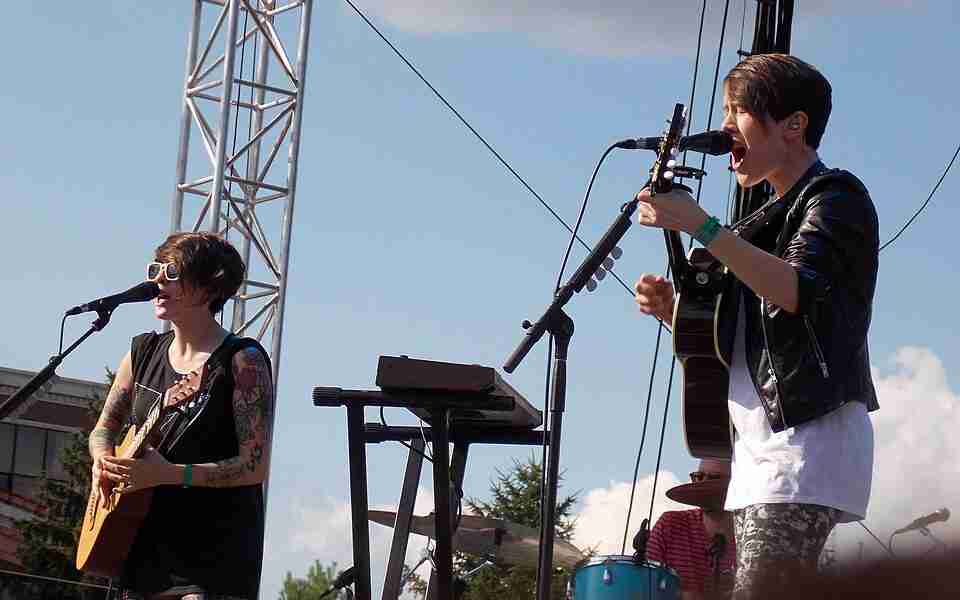

Tegan and Sara: The Twin Songwriters Who Made Their Relationship the Work
Most twins spend at least some of their adult life putting distance between themselves and each other — different cities, different careers, different friend groups. Tegan and Sara Quin did the opposite. The identical twin sisters from Calgary, Alberta, born September 19, 1980, built one of the most enduring careers in indie music by choosing to work together every single day for three decades. That choice — made freely, renewed constantly, and complicated by everything that makes twins complicated — is what makes them one of the more instructive examples in any conversation about twin identity.
They are not a novelty act. They are not performing twinhood. They are two identical twins who happen to have built a shared professional life — and who have been honest, sometimes brutally so, about what that costs and what it gives them.
They Started Before Anyone Was Watching
Tegan and Sara began writing songs at fourteen, recording demos on cassette tapes in their bedroom in Calgary. Their mother was a therapist. Their stepfather played guitar. They grew up in a household that talked openly about feelings — and, as Tegan noted in a Reddit AMA, occasionally too openly. They were normal teenagers who hid things from their mom like everyone else. But therapy was never foreign to them, and that comfort with emotional vocabulary would eventually define their songwriting.
By the time they were seventeen, they had used their high school’s recording studio to produce two demo albums. In 1998, they won Calgary’s Garage Warz competition — the prize was professional studio time — and recorded their first real demo under the name Sara and Tegan. That same year they opened for Hayden in Calgary, their first major show. The following year, after releasing their debut independently, they were discovered by Elliot Roberts, Neil Young’s longtime manager. He flew to Vancouver to see them at the Starfish Room and offered them a record deal the same night. They were nineteen.
What followed was the kind of slow, methodical career build that is increasingly rare: a decade of touring, a fan base earned show by show, and a critical reputation that grew with each album. Identical twins share DNA but develop distinct creative voices — that divergence is audible across every Tegan and Sara record. They have always written separately, bringing finished or near-finished songs to each other rather than co-writing in the traditional sense. The result is an album dynamic where two distinct sensibilities are in conversation without either collapsing into the other.
Ten Albums, One Constant
Tegan and Sara have released ten studio albums, spanning indie folk, indie rock, and a sharp pivot into synth-pop with 2013’s Heartthrob that surprised longtime fans and introduced them to an entirely new audience. The lead single from that album became their commercial breakthrough — sleek and propulsive, landing in television soundtracks and playlists far outside the alternative world they had come up in. Their 2014 collaboration on “Everything Is Awesome” for The Lego Movie soundtrack reached an audience of millions who had never encountered them before.
The awards followed the work: three Juno Awards, two GLAAD Media Awards, two Polaris Music Prize nominations, and a Grammy nomination in 2013 for Best Long-Form Music Video for their live package Get Along. Their most recent studio album, Crybaby, was released in 2022.
In 2019, they published a memoir, High School — co-written, co-told, a portrait of adolescence in Calgary in the mid-1990s, of figuring out their sexuality, of starting to write songs while their family didn’t fully know what they were making yet. It became a New York Times bestseller and was adapted into a television series for Amazon Freevee in 2022.
The Tegan and Sara Foundation came out of a specific moment of overwhelm. After Heartthrob‘s commercial success, they found themselves fielding an unmanageable volume of requests to raise money for a wide range of causes. As they prepared their next album, they decided to formalize what had been ad hoc — to build an organization that could focus resources deliberately on LGBTQ+ women and girls. It was founded in 2016. It is not a side project.
What They’ve Said About Being Twins
Something worth noting about Tegan and Sara’s early press: in their first decade of interviews, journalists were often more preoccupied with the twin dynamic than with their music or sexuality. Tegan has reflected that early coverage leaned heavily into the idea of sibling rivalry — the angle that made the story legible to a mainstream music press that was largely older and male. It took until roughly 2010–2014, as the press corps itself diversified, for the questions to shift toward their identity and activism.
That observation matters because it maps closely to something many twins report: the twin relationship becomes the story that other people want to tell, often at the expense of the individuals inside it. Tegan and Sara navigated that for a decade before the world’s curiosity caught up with who they actually were.
On the twin relationship itself, they are candid without being performative. They don’t always get along. They go through rough patches. They have used therapy to develop new communication styles over the years. When asked about the stress of making so many decisions together, Tegan’s answer is flat and practical: they reset when things get bad, set goals before difficult conversations, and keep going. There is no display of closeness — Sara’s presence in Tegan’s life is treated as a structural given, not something precious to exhibit.
The practical upside is also something they acknowledge plainly: they divide and conquer. One handles press while the other is on set. Having someone who shares your entire professional history and most of your personal one means never having to explain yourself from the beginning. That is the twin advantage that rarely gets discussed outside of twin communities — not finishing each other’s sentences, but already knowing the full context of whatever the other person is dealing with.
The Architecture of a Shared Life
For adult twins thinking about what twinhood looks like at scale — played out over decades, under public pressure, with real stakes — Tegan and Sara are a useful data point. They have not resolved the tension between individuality and twinship. They have built a career inside it.
They write separately. They perform together. They have different personalities, different relationships, different ways of managing anxiety and creative blocks and life on the road. And they chose, repeatedly, to remain professionally inseparable. That is a specific kind of twin story — not the one about growing apart and finding yourself, and not the one about being so close you share a single identity. It is the one about two people who know each other completely and keep choosing the same room anyway.
That room, for them, happens to be a stage. But the choice behind it is one that any twin will recognize.